
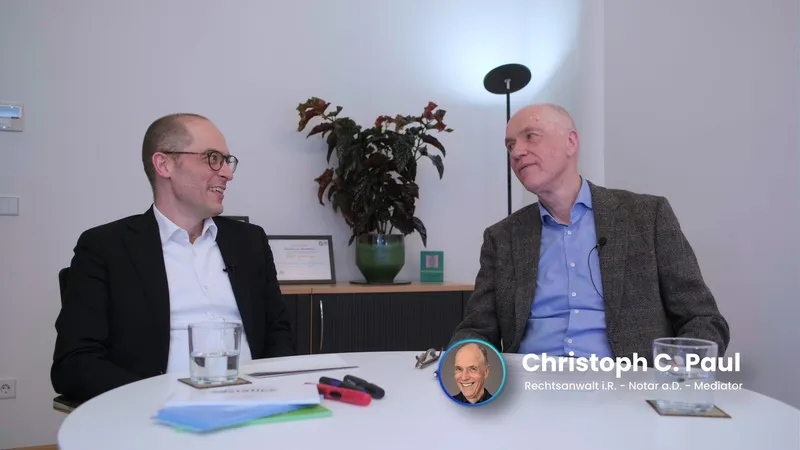
Mediation in Family Businesses – In Conversation with Christoph C. Paul
I had the valuable opportunity to speak with Christoph Paul about mediation in family businesses. Christoph is a mediator of the first hour who has strongly shaped both the mediation landscape in Germany and me personally. He supported and accompanied me as a mentor. Without him, I would not be the mediator I am today. Together we have, among other things, conducted seminars at Osaka University, which I look back on with great fondness.
Christoph's primary profession is as a lawyer and notary, and he began his work as a mediator with training in 1995. Family businesses are one of his favorite areas of activity: he originally came from family mediation, and through his connection to his work as a lawyer and notary, a stronger focus on inheritance mediation and mediation in family businesses developed later. The question of business succession is an important focus of his work.
Childhood and Formative Experiences
Christoph grew up in a sheltered childhood. He grew up in the 1950s in Oldenburg, then still a quiet small town.
An episode that still shapes him today: He was about 8 years old at the time. Shelves were to be built in the basement – for the files of his father, who was himself a lawyer and notary. An older man was asked to build the shelves. He came with old boards, strips, hammer and nails. His father bought little Christoph a small hammer, a pair of pliers and a handsaw, and said to the old gentleman: "Here is my son, he is now your assistant. Teach Christoph what you know. Christoph, you help him now."
Christoph then built the shelves together with this old gentleman. He did his best, took measurements, hammered in nails, and occasionally hit his own fingers, pulled out crooked nails to hammer them in straight again. In the end, there was a set of shelves that was used naturally and without question until the family moved out of that house.
"This trust in me and in my ability as a little craftsman – you'll manage – shaped me deeply. And that is also something that is formative for mediation. I always have the idea: I believe they can do it. Sometimes you just have to say: Pull the nail out again, you can hammer it in straight."
A second formative experience was the international dimension: Christoph's father was Norwegian by birth. When Norwegian cousins came to visit, there was always a tremendously good atmosphere in the house. "International simply meant good mood – and excitement." This openness to the international has influenced his entire life to this day.
The Path into Mediation
After 17 years as a lawyer and notary, Christoph thought: There must be something more. There are certainly some psychological dynamics that play a role in conflict resolution and that should be taken into account. His wife, who is a psychotherapist, certainly gave him some food for thought in this direction.
In 1995 Christoph found a flyer: Mediation training. "I thought: That's it. And I'm glad that I immediately took this path, which has significantly shaped and changed my life." A gut decision – which proved to be absolutely right.
He had the good fortune to be able to integrate mediation fully into his professional daily life: one third as a lawyer, one third as a notary, one third as a mediator. As a lawyer, he examined how far cases were suitable for mediation and recommended other mediators. In his notarial work, he used the tools of consensual settlement that he had learned in mediation. And in mediation, he could well assess the legal framework.
Christoph also became involved in professional politics: twelve years as spokesperson for the Federal Working Group for Family Mediation, involvement in an expert committee on the Mediation Act. In 2002, he was asked by the Federal Ministry of Justice whether the association MiKK e.V. could offer mediation in international child abduction cases – a task he took on with great passion and for which he co-developed Cross-Border Family Mediation.
"Currently it is the mediator" – that is how Christoph answers the question about his identity. For many years all three areas existed side by side as equals, and all three fulfilled him enormously.
What is Mediation?
For those considering mediation: Mediation is a structured process in which the parties involved in a conflict are assisted, with the support of a third party – one or more mediators – in finding a solution to their conflict situation for which they themselves take responsibility.
The principles: voluntariness, confidentiality, balanced appreciation, self-responsibility. For outsiders, the process initially appears confusing. That is precisely why it is the task of the mediators to give the conversation structure and a framework. In the ideal case, the process ends with an agreement that resolves the conflict.
"It is not about solving the conflict – that is a somewhat too high an expectation. But one tries to find a solution that gives the parties a chance to take the next steps – either with a view to continued joint collaboration or with a view to a clear, successful separation."
How Does Mediation Work in Family Businesses?
Family businesses have the special feature that three fields interlock: on the one hand the family with all the values it contains; secondly the company, which operates according to completely different principles; and then the assets, the property, which forms the financial basis of all of this.
Especially in questions of succession and restructuring, this is often an "endless tangle." Mediation helps the parties to focus on their interests in these three different fields. This enables a process of clarification and then a process of design.
"I experience time and again in the area of business succession: That's great, we can do it like that! Many are surprised by what is possible, what seemed completely unthinkable at the beginning and what then becomes clear in the process."
The family with all its loyalties, disappointments, wishes, longings, with love or disappointed love always interferes in the business, where completely different principles apply. Helping the parties to gain structure and clarity there – that is the task of the mediator.
An Example from Practice
Christoph describes a case – somewhat altered to preserve confidentiality.
The protagonists: A father, well over 70, took over a farm on the outskirts of a large city and developed it as an event location for weddings and birthdays, built up a catering business and restored the once dilapidated farm. When an illness was diagnosed, he began thinking about business succession within the family.
The daughter from his first marriage, in her mid-twenties, had grown up on this farm and had for some time been working in event management. The father asked her whether she wanted to take over the business.
The third party involved was the second wife, who also lived on the farm and had contributed a substantial amount of money. With this money, a large extension was financed. She lived there with the two young children from the second marriage.
Contact came through the daughter, who called Christoph and outlined the situation. In the first session, attended only by the father and daughter, Christoph asked the question he always asks: "Why are you actually coming to me and not doing this at the kitchen table at home?"
"It quickly became clear that this simply didn't work for them. The daughter said: My father is a hothead. As soon as I say anything, he's through the roof. And that simply doesn't work between the two of us."
Christoph then worked with the concept of the charismatic – because a hothead has another side too. He developed with the father what he had built up: how thirty years ago he had bought this farm more or less as a ruin, had lived there and developed everything. "Through this personal dimension of charisma I had him – there I had him personally, and he could unfold himself and his work."
They then worked together for half a year – sometimes in a group of three, sometimes four with the second wife. Many questions had to be clarified: Where can the daughter live if she moves to the farm? How are the young children taken into account? How is the father cared for in old age? How does the second wife secure her contributed capital?
The result: The daughter received 51% of the business shares with the option to take over the remaining 49% upon the father's death. The management question was tricky: the daughter insisted on sole management, which was unthinkable for the father. As a transitional solution, both managed together.
The second wife received the new building as her sole property – in exchange for waiving the loan she had given the father. She runs the bed and breakfast as her own business. "A nice example of how creative the solutions in mediation can be – and a great advantage of being able to plan individual phases."
How Do Family Businesses Find Their Way to Mediation?
Most people, when faced with complex problems like business succession, don't first turn to mediators, but to lawyers, tax advisors, auditors. This has the advantage that they can delegate and let others do things. But they also lose the opportunity to shape things themselves.
"Mediation and legal advice are not mutually exclusive – it is not an either/or. Lawyers and tax advisors have their role in the process. The communicative aspect, the real exchange, is better placed in mediation."
What always impresses Christoph: people who have run companies are people who have created something. When that innovative force, that vision they have developed, can now unfold once more in a new form – that is impressive.
An Appeal in Closing
"Mediation is always worth a try. The added value of working something out on one's own responsibility is, in my experience, enormous. Families know their family better than anyone else. The people who are in the business know the business better than anyone else. People know exactly how the assets were built up and what they must serve."
Christoph speaks of the respect he has for people who go into mediation: "These are people who face up to their own possibilities and look for creativity within themselves and work on it. They dare something."
And his practical advice: Look at which mediator suits you. Who fits personally, who fits humanly, who brings the possibilities that you have in mind? Try it out.
"Dare it. Go into mediation. Try it. Experience teaches that it is an effective process that truly harbors an incredible potential." – Christoph Paul
Watch the Full Interview
You can watch the complete conversation with Christoph Paul on YouTube: